Ebook The Understanding by Design Guide to Creating High-Quality Units
Spend your time also for just couple of minutes to review a publication The Understanding By Design Guide To Creating High-Quality Units Reviewing an e-book will never reduce as well as squander your time to be ineffective. Checking out, for some folks become a requirement that is to do daily such as spending time for consuming. Now, exactly what concerning you? Do you want to read a book? Now, we will reveal you a new book qualified The Understanding By Design Guide To Creating High-Quality Units that could be a new means to discover the expertise. When reading this publication, you can get one point to constantly remember in every reading time, even step by action.
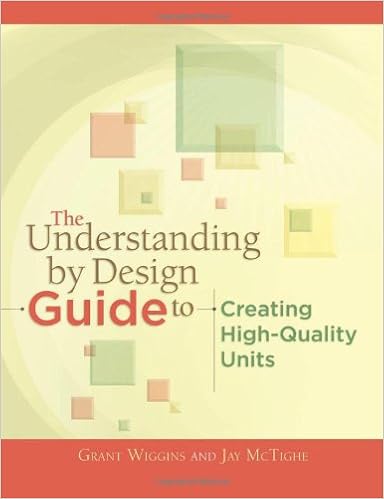
The Understanding by Design Guide to Creating High-Quality Units

Ebook The Understanding by Design Guide to Creating High-Quality Units
Book The Understanding By Design Guide To Creating High-Quality Units is one of the precious well worth that will certainly make you always abundant. It will certainly not suggest as abundant as the cash provide you. When some people have absence to deal with the life, people with lots of e-books often will certainly be better in doing the life. Why ought to be book The Understanding By Design Guide To Creating High-Quality Units It is in fact not suggested that publication The Understanding By Design Guide To Creating High-Quality Units will provide you power to get to every little thing. Guide is to review and also exactly what we implied is guide that is read. You could likewise see how guide entitles The Understanding By Design Guide To Creating High-Quality Units as well as varieties of e-book collections are providing here.
Reading is sort of need to do on a daily basis. Like exactly what you do your daily tasks, consuming or doing your daily activities. As well as now, why should be reading? Reviewing, once more, can assist you to discover brand-new manner in which will certainly get you to life much better. That's not what you call as the obligation. You could review The Understanding By Design Guide To Creating High-Quality Units in the leisure as additional tasks. It will not also obligate you to read it for several web pages. Just, by actions and you can see how this publication interestingly.
The factor of many individuals picks this The Understanding By Design Guide To Creating High-Quality Units as the reference reveals because of the demands in this day. We have some specific methods exactly how the books exist. Beginning with the words options, attached subject, and also easy-carried language design, exactly how the writer makes this The Understanding By Design Guide To Creating High-Quality Units is really easy. Yet, it includes the professional that could influence you much easier.
Ease of the language and also simple jobs to understand come to be the factors of lots of people attempt to obtain this publication. When you wish to locate more concerning The Understanding By Design Guide To Creating High-Quality Units, you could see who the writer is, that the person that has created guide is. Those will be far more incredible. Thus, you could check out the page with the web link that we provide in this write-up. It will not be so complex for you. It will be a lot easier to acquire.
From the Inside Flap
The Understanding by Design Guide to Creating High-Quality Units offers instructional modules on the basic concepts and elements of Understanding by Design (UbD), the "backward design" approach used by thousands of educators to create curriculum units and assessments that focus on developing students' understanding of important ideas. The eight modules are organized around the UbD Template, version 2.0, and feature components similar to what is typically provided in a UbD design workshop, including * Discussion and explanation of key ideas in the module; * Guiding exercises, worksheets, and design tips; * Examples of unit designs; * Review criteria with prompts for self-assessment; and * A list of resources for further information. This guide is intended for K 16 educators either individuals or groups who may have received some training in UbD and want to continue their work independently; those who've read Understanding by Design and want to design curriculum units but have no access to formal training; graduate and undergraduate students in university curriculum courses; and school and district administrators, curriculum directors, and others who facilitate UbD work with staff. Users can go through the modules in sequence or skip around, depending on their previous experience with UbD and their preferred curriculum design style or approach. Unit creation, planning, and adaptation are easier than ever with the accompanying downloadable resources, including the UbD template set up as a fillable PDF form, additional worksheets, examples, and FAQs about the module topics that speak to UbD novices and veterans alike.
Read more
About the Author
Grant Wiggins is president of Authentic Education in Hopewell, NJ. He earned his EdD from Harvard University and his BA from St. John's College in Annapolis. Grant and his colleagues consult with schools, districts, and state and national departments on a variety of reform matters. He and his colleagues also organize conference and workshops, and develop print and web resources on key school reform issues.Grant is perhaps best known for being coauthor, with Jay McTighe, of Understanding by Design, the award-winning and highly successful program and set of materials on curriculum design used all over the world, and of Schooling by Design. He is also a coauthor for Pearson on more than a dozen textbook programs in which UbD is infused and his articles have been published in several leading journals including Educational Leadership and Phi Delta Kappan. Grant is widely known for his work in assessment reform. For 25 years, he has worked on influential reform initiatives around the world, including Ted Sizer's Coalition of Essential Schools; the International Baccalaureate Program; the Advanced Placement Program; state reform initiaves in New Jersey, New York, and Delaware; and national reforms in China, the Philippines, and Thailand.  He was a lead consultant on many state assessment reform initiatives, such as the portfolio project in Vermont and peformance assessment consortia in New Jersey and North Carolina. Grant's work is grounded in 14 years of secondary school teaching and coaching. Jay McTighe brings a wealth of experience developed during a rich and varied career in education. He served as director of the Maryland Assessment Consortium, a state collaboration of school districts working together to develop and share formative performance assessments. Prior to this position, Jay was involved with school improvement projects at the Maryland State Department of Education where he directed the development of the Instructional Framework, a multimedia database on teaching. Jay is well known for his work with thinking skills, having coordinated statewide efforts to develop instructional strategies, curriculum models, and assessment procedures for improving the quality of student thinking. In addition to his work at the state level, Jay has experience at the district level in Prince George's County, Maryland, as a classroom teacher, resource specialist, and program coordinator. Jay is an accomplished author, having coauthored 10 books, including the best-selling Understanding by Design series with Grant Wiggins. He has written more than 30 articles and book chapters, and has published in leading journals, including Educational Leadership (ASCD) and The Developer (National Staff Development Council). Jay received his undergraduate degree from the College of William and Mary, earned his master's degree from the University of Maryland, and completed post-graduate studies at the Johns Hopkins University. He was selected to participate in the Educational Policy Fellowship Program through the Institute for Educational Leadership in Washington, D.C.
Read more
Product details
Paperback: 122 pages
Publisher: ASCD; 1 edition (January 1, 2011)
Language: English
ISBN-10: 1416611495
ISBN-13: 978-1416611493
Product Dimensions:
8.5 x 0.5 x 10.5 inches
Shipping Weight: 10.4 ounces (View shipping rates and policies)
Average Customer Review:
4.3 out of 5 stars
238 customer reviews
Amazon Best Sellers Rank:
#36,114 in Books (See Top 100 in Books)
UbD is a great instructional concept, but it tries to be too much and fails to deliver meaningful quality content for both new and experienced teachers. It almost seems as if Wiggins tries to reinvent what teachers should do but takes two steps back and says "use what fits your needs." The books were supposedly created to be read in any order, but each chapter references other chapters and reuses graphics. Sometimes it appears as if Wiggins is trying to reinvent what was already made: Bloom's Taxonomy and verbs, different forms of formative assessment, and teaching practices that I am already aware of before I read the book. In fact, it was difficult to understand what exactly is UbD until about chapter 5, which could have easily been stated much earlier than saying "it's complicated" and not providing a clear blueprint. The first few chapters seem more like an attempt to sell a concept like a TV commercial.Much of the work consists of visual grids, forms, and graphs that sometimes make the concepts more confusing than helpful. The process of constructing lesson plans is further complicated by using abbreviations that serve little purpose other than to the lesson writer himself. In other words, unless your colleagues also understand your specific design, a UbD lesson plan would not be understood by even a well-trained educator. It attempts to create vague templates with so much room that nothing seems concrete, such as evaluative criteria, objectives, and daily lessons. Don't believe me? Just read the template about a driving lesson, there is no scoring guide next to its "criteria" to show level of performance. GRASPS is nearly the same. Even with the Forms/FAQ, I left more confused than enlighted about some "revolutionary" design concept.Furthermore, there is a danger in overusing the "understanding" method of teaching, especially in lower grades (K-5). There is so much emphasis on higher-level thinking that it suggests taking away assessment of other knowledge in order to obtain "a mile deep and an inch wide" level of understanding. The author wants students to make meaning of their learning in a complex way rather than just recall the material. While I agree that students should learn in a meaningful way, the level of depth can be inappropriate for lower grades in given subjects as suggested, such as math.Summary:UbD can be best described as a way for teachers to organize what they already know how to do while adding a level of complexity to the process. Emphasis on content the teacher already knows. This includes unnecessary labels (AMT, WHERETO, GRASPS, Facets), renaming lesson planning norms (rubrics, big ideas, essential questions, unpacking standards, differentiated instruction), and generic classroom instructional strategies (see table of content in "Classroom instruction that Works"). I bought this for a college class and felt that I got nothing out of this series, not even as a new teacher. While I acknowledge that there are some reviewers who feel that this book has been life-changing, I prefer concrete and specific plans to help me reflect on my practices a year later. UbD is merely a "thinking process" to help one focus on what they intend for their students to learn. It is best suited for upper grades and must heavily be modified to work with elementary students. I may use UbD as a curriculum map, but certainly not for teaching lessons.
This is a useful text for planning lessons or units that follows up the UbD text written by the same authors. It is not a book about philosophy or learning theories. It's only about what principles and questions teachers should take into account when planning. There is no rigid following of a template or guidelines. What are the principles espoused by W & M? That lesson planning should be geared toward "understanding" rather than rote memory, and that it should begin with desired results, then move to assessment techniques, and finally, to the activities. This process is called "backward design." If students "understand," then they may be able to transfer the acquired knowledge to solve problems and make decisions, making learning more meaningful. The authors also discuss the four learning goals - transfer, meaning, knowledge, and skills - and the three stages of learning - acquisition, meaning-making, and transfer. These latter three did not appear on the original UbD.Although the authors discuss many of the ideas covered in the early UbD text, the templates, the dialogues, and the guiding questions make this text an excellent complement to that first text. This is not to mention that this is adaptable to the recently established Common Core Standards. The dialogues were a great way of showing significant differences between mere coverage of content, and meaningful learning. This latter concept is achieved by asking Why am I teaching this to my students? What do I expect students to do with the skill or content?This book is not anti-standards or anti-standardized exams. It is not a critique against any particular public policy although the authors have criticized the excessive number of standards, and policies that encourage teaching by the test (they did so in UbD).On the contrary, this book helps teachers enhance their lesson planning and meet goals established by standards and educational policies in a more effective way, without sacrificing learners' academic development.This is one of the most useful books on lesson planning that I've read so far. It's also an eye-opener as to what education should be about. It avoids getting into fruitless debates about what os the True philosophy or scientific theory about learning. Very practical. I recommend it to any teacher who wants to improve lesson planning in the classroom.
I think the ideas are valid, but it seems the authors are overcomplicating the content and concepts. Everything that needs to be said could be done in half as many pages. It's ridiculously redundant.
Definitely a must have for any educator. Wiggins and McTighe are almost the pioneers in this field and thought of backwards design (Robert Tyler first thought of the concept in his published work from 1947) and their concepts are easy to implement and are what I would call a no-brainer. As in it should be something that all teachers are already implementing in their lesson and unit planning already. However, we all know that it is not already in the forefront of every educators mind or else there would not be a need for this book. This book will definitely teach the educator or potential educator how to start to think about the goals of a lesson and then to plan the lessons on how to get each student to those specific goals (backwards design). It is an easy concept and once understood and fully grasped by the educator he/she can start to educate their students in a way in which the students will benefit by truly gaining meaningful knowledge from the course they are taking with the educator and be able to apply the knowledge and demonstrate understanding.
I had to read this book for a graduate course, and it is, quite possibly, one of the most enlightening education texts I have ever read. I bought the kindle version for the course, but I'm planning on buying the print edition so that I can re-read it, with more notes. It's that good. I wish I had read it years ago, and I have found it's impacted my teaching from chapter one. I'm encouraging my principal to offer it as a book study.
The Understanding by Design Guide to Creating High-Quality Units PDF
The Understanding by Design Guide to Creating High-Quality Units EPub
The Understanding by Design Guide to Creating High-Quality Units Doc
The Understanding by Design Guide to Creating High-Quality Units iBooks
The Understanding by Design Guide to Creating High-Quality Units rtf
The Understanding by Design Guide to Creating High-Quality Units Mobipocket
The Understanding by Design Guide to Creating High-Quality Units Kindle