
Free PDF The Chicago Guide to Grammar, Usage, and Punctuation (Chicago Guides to Writing, Editing, and Publishing)
The book includes everything new as well as appealing to read. The selection of subject as well as title is actually different with various other. You could feel this book as one of the intriguing book since it has some advantages and also possibilities for transforming the life better. And now, this publication is readily available. Guide is situated with the lesson and information that you need. Yet, as easy publication, it will certainly not need much idea to review.
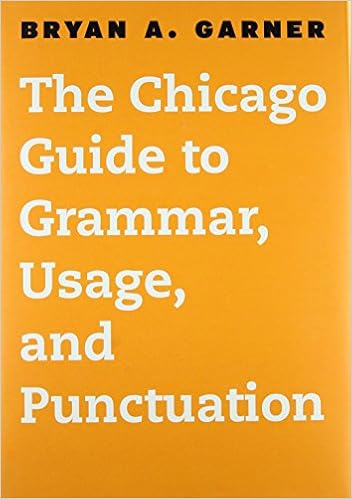
The Chicago Guide to Grammar, Usage, and Punctuation (Chicago Guides to Writing, Editing, and Publishing)

Free PDF The Chicago Guide to Grammar, Usage, and Punctuation (Chicago Guides to Writing, Editing, and Publishing)
Do not change your mind when you are starting to intend to have reading behavior. This behavior is a good as well as wonderful habit. You need to enliven it with the very best books. Lots of publications reveal and also present there unbelievable content based upon each genres as well as topics. Also each book has different preference of writing; they will give far better problem when checked out extremely well. This is just what makes us proudly present The Chicago Guide To Grammar, Usage, And Punctuation (Chicago Guides To Writing, Editing, And Publishing) as one of guides to read now.
And also below, that book is The Chicago Guide To Grammar, Usage, And Punctuation (Chicago Guides To Writing, Editing, And Publishing), as you need it complying with the topic of your obstacles. Life is challenges, jobs, as well as obligations are likewise challenges, and also there are lots of things to be obstacles. When you are absolutely confused, just get this book, and also pick the important details from guide. The content of this could be made complex and also there are lots of styles, yet reading based upon the subject or reading page by web page can help you to recognize just that publication.
Get the perks of checking out routine for your lifestyle. Book The Chicago Guide To Grammar, Usage, And Punctuation (Chicago Guides To Writing, Editing, And Publishing) notification will certainly consistently associate with the life. The actual life, understanding, scientific research, health, religion, enjoyment, as well as much more could be discovered in composed publications. Several authors provide their encounter, science, research study, and also all things to show you. Among them is with this The Chicago Guide To Grammar, Usage, And Punctuation (Chicago Guides To Writing, Editing, And Publishing) This e-book The Chicago Guide To Grammar, Usage, And Punctuation (Chicago Guides To Writing, Editing, And Publishing) will certainly provide the required of message and statement of the life. Life will certainly be completed if you know more things with reading publications.
From the explanation above, it is clear that you should review this book The Chicago Guide To Grammar, Usage, And Punctuation (Chicago Guides To Writing, Editing, And Publishing) We supply the online book qualified The Chicago Guide To Grammar, Usage, And Punctuation (Chicago Guides To Writing, Editing, And Publishing) here by clicking the web link download. From discussed e-book by online, you can offer a lot more perks for numerous people. Besides, the readers will be likewise quickly to obtain the favourite publication The Chicago Guide To Grammar, Usage, And Punctuation (Chicago Guides To Writing, Editing, And Publishing) to review. Discover one of the most favourite as well as needed e-book The Chicago Guide To Grammar, Usage, And Punctuation (Chicago Guides To Writing, Editing, And Publishing) to read now as well as below.
Review
“[A manual] for those of us laboring to produce expository prose: nonfiction books, journalistic articles, memorandums, business letters. The conservatism of his advice pushes you to consider audience and occasion, so that you will understand when to follow convention and when you can safely break it. When someone offers you good advice, you would do well to take it.” (John E. McIntyre Baltimore Sun)"The Chicago Guide is not what I expected, but it is what I had hoped for. There are a lot of grammar books available and a lot of sharply focused books on specific items . . . but there aren’t many, if any, that are comprehensive and accessible. The Chicago Guide certainly is accessible and comprehensive." (An American Editor)“This grammar book doesn’t shoot and leave. It stays with you.” (Hamodia)“Writers, copy editors, and students seeking advice or explanations of the conventions of standard literary English will find definitive, clearly expressed rulings in The Chicago Guide to Grammar, Usage, and Punctuation. . . . Essential." (Choice)“Garner’s guide is well-organized, logical, comprehensive, up-to-date, and comes alongside the reader in his or her search for clear as well as correct language (the second is not always the first).” (Reference Reviews)“At last, everything I had long been looking for in a single volume presented logically and explained adequately in terms that any interested reader can not only follow but also make his or her own with a little due diligence and old-fashioned intellectual elbow grease.” (Thomas R. Claire Publishing Research Quarterly)“A grammar companion such as this one to CMS and an authoritative dictionary would establish language authority across company texts. Therefore, this work is highly recommended.” (Technical Communication)“A thoroughgoing, clear explication of the traditional categories of grammar, expanded from his summary in The Chicago Manual of Style and a fit companion to Garner’s Modern English Usage.” (John E. McIntyre, author of The Old Editor Says)“Garner is the greatest writer on grammar and usage that this country has ever produced. This book will be an instant classic.” (David Yerkes, Columbia University)
Read more
About the Author
Bryan A. Garner is president of LawProse, Inc. and Distinguished Research Professor of Law at Southern Methodist University. He is the author of the "Grammar and Usage" chapter of The Chicago Manual of Style and editor in chief of Black’s Law Dictionary. His many books on language and law include Garner’s Modern English Usage and Legal Writing in Plain English, the latter from the University of Chicago Press.
Read more
Product details
Series: Chicago Guides to Writing, Editing, and Publishing
Hardcover: 552 pages
Publisher: University of Chicago Press; 1 edition (May 16, 2016)
Language: English
ISBN-10: 9780226188850
ISBN-13: 978-0226188850
ASIN: 022618885X
Product Dimensions:
7 x 1.7 x 10 inches
Shipping Weight: 2.4 pounds (View shipping rates and policies)
Average Customer Review:
4.6 out of 5 stars
18 customer reviews
Amazon Best Sellers Rank:
#119,121 in Books (See Top 100 in Books)
This book is essentially an expansion of Garner's usage chapter from the CHICAGO MANUAL OF STYLE with a distinct emphasis on correctness rather than the style, workflow, and formatting covered in CMOS. And that's a good thing, as it focuses on helping writers at all levels. Less pedantic (in my opinion, anyway) than GARNER'S MODERN ENGLISH USAGE, and more accessible as a result, it follows a similar structure to that of CMOS. Some may find GARNER'S MODERN ENGLISH USAGE hard to follow because the head entries are alphabetical, and for those readers this book will seem more logical as it is grouped by typical subjects (e.g., prepositions, clauses, subjects, verbs). Other huge selling points are a 100-page subchapter titled Troublesome Words and Phrases, a 32-page Word Index, and an 88-page Select Glossary (I wonder what the Unabridged Glossary looks like). All of these are great aids for less-experienced writers or those who find certain indexing styles particularly vexing (nearly always the fault of the author or indexer, not the reader, by the way, and I'm not being sarcastic in this particular instance).One reason I like Garner's other book is its use of relevant and user-friendly examples. CMOS is not always so generous with such examples, though it is improving. The CHICAGO GUIDE TO GRAMMAR, USAGE, AND PUNCTUATION uses numerous examples in every section, and in many cases it divides them into "good usage" and "bad usage" categories to show both right and wrong variations. I find this much more helpful in explaining usage to others and it should aid comprehension for many readers. Garner also uses word-frequency data to show the prevalence of certain word forms and their lexicological competitors.This book is an excellent reference choice for writers at all levels (editors also will find good examples to clarify usage for themselves and clients). And a word for those who've heard that Garner is prescriptivist—he only seems prescriptivist for those rules that good writers do and should follow to ensure that readers take them seriously. He often points to certain uses that just don't matter so much anymore (e.g., he notes that "hopefully" is still avoided by good writers, but that the differentiation is likely lost on most readers and therefore not so important). And in case you wondered whether all those actors who pronounce "homage" as "OH-MAUGE' " and "often" as "OFT' EN" were just being pretentious—they are (of course I'm biased—otherwise, why would I write a silly review?).And finally (I presume you are cheering), at least Garner had the knowledge and good sense to provide a proper title for his book, unlike those numerous ones calling "usage" "grammar" and "grammar" "usage" without any hint of shame.
Absolutely love this as a companion to the Chicago Manual of Style. It's clear, concise, and pretty easy to navigate, and it offers supplemental examples that the CMS does not. I'm extremely happy with this and the CMS as a style manual. Match it with a good dictionary like Random House and a solid thesaurus, and you'll never need the internet again.
Here is a welcome extension volume to Garner's acclaimed Modern English Usage; together they make an invaluable source of articulate, authoritative, convincing (and witty) discussions of many of the problems that writers and editors of quality prose will encounter.
Garner’s usage guides are invaluable, but it’s difficult to figure out who would want this book. Lovers of grammar will be frustrated, and anyone trying to learn the complexities of grammar and punctuation will be misled. For one thing, Garner muddles the terminology. On the very page (165) on which he defines a clause as “a grammatical unit that contains a subject, a finite verb, and any complements that the verb requires,†he presents as an example of a subordinate clause the word-group “despite my father’s warning not to†(which is a phrase, not a clause, because it lacks a finite verb). Discussing the bracketed word-group “we’re making progress slowly but surely†on page 146, he claims that “but joins two adverbs within an adverbial clause,†but that word-group is an independent clause, not an adverbial dependent clause. Garner doesn’t always have a sure grasp of the parts of speech, either. He classifies “through†in the sentence “I’d like to see the problem through†as a preposition (page 139), but “through†is an adverb in that instance. For Garner, terms change meaning from page to page. On page 127, he defines an adverb as a “wordâ€; on page 85, he illustrates his statement that “it is now widely acknowledged that adverbs sometimes justifiably separate the to from the principal verb†with the sentence “[T]hey expect to more than double their income next year.†“More than†doesn’t satisfy his definition of an adverb as a single word; it’s a phrasal adverb, which he defines elsewhere. Explanations are opaque (from page 143: “The conjunction joins a clause. . . .†Hunh?). Examples don’t always relate to the rules they are intended to illustrate. On page 375, the rule “Use a hyphen to connect the parts of a phrasal adjective—that is, a phrase whose words function together to modify a noun†is illustrated with the sentence “Being competitive, risk-taking, status-conscious, dedicated, single-minded, persevering—it can make all the difference to success,†in which there’s no noun for those phrasal adjectives to modify. Although the book has the imprimatur of the University of Chicago Press, the discussion of punctuation trashes rules in The Chicago Manual of Style, including 6.20 and 6.45 (rules identical to those enforced at The New Yorker). The section on punctuation is in fact the weakest in the book. Even though each chapter discusses common misuses of punctuation marks, the chapter on the slash does not even address the most controversial and disputed use of the slash—to mean “and†rather than “or.†(The discussion of the slash in his usage books is much more helpful.) The chapter on colons never explicitly states that an independent clause must almost always precede a colon. (And he discusses only one misuse of the colon, though in his usage books he discusses four misuses.) One can go on and on. Bryan Garner is a whiz, no question, but this book needs a redo. Buy one of his usage books instead. They’re a better bargain, they’re more comprehensive, and they’re brilliant!
I'm an author and needed some indepth grammar guidelines. The Chicago Guide to Grammar Usage satisfied that need.
I use this is a companion to the Chicago Manual of Style, and define my whole department's grammatical usage by this book. It's the one to go to.
Anything by Bryan A. Garner is excellent if you're interested in grammar and the meaning of words.
An excellent accompaniment to style books, such as the Chicago Manual of Style, and also to Garner's Modern English Usage.
The Chicago Guide to Grammar, Usage, and Punctuation (Chicago Guides to Writing, Editing, and Publishing) PDF
The Chicago Guide to Grammar, Usage, and Punctuation (Chicago Guides to Writing, Editing, and Publishing) EPub
The Chicago Guide to Grammar, Usage, and Punctuation (Chicago Guides to Writing, Editing, and Publishing) Doc
The Chicago Guide to Grammar, Usage, and Punctuation (Chicago Guides to Writing, Editing, and Publishing) iBooks
The Chicago Guide to Grammar, Usage, and Punctuation (Chicago Guides to Writing, Editing, and Publishing) rtf
The Chicago Guide to Grammar, Usage, and Punctuation (Chicago Guides to Writing, Editing, and Publishing) Mobipocket
The Chicago Guide to Grammar, Usage, and Punctuation (Chicago Guides to Writing, Editing, and Publishing) Kindle
0 komentar:
Posting Komentar