
Download The Awesome Power of Direct3D/DirectX - The DirectX 7 Version, by Peter J. Kovach
Reading publications will not obligate you to finish it in a day. After your reading book currently, The Awesome Power Of Direct3D/DirectX - The DirectX 7 Version, By Peter J. Kovach can be the picked book to be. We recommends because of the high quality of this book. It includes something brand-new as well as various. You may not have to assume significantly, however just check out and you will certainly see why this book is much suggested.
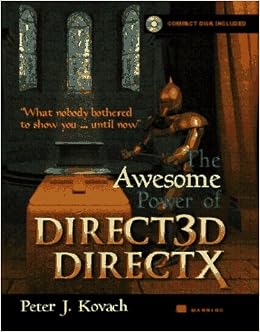
The Awesome Power of Direct3D/DirectX - The DirectX 7 Version, by Peter J. Kovach

Download The Awesome Power of Direct3D/DirectX - The DirectX 7 Version, by Peter J. Kovach
After couple of time, finally guide that we and also you await is coming. So eliminated to obtain this wonderful publication offered to offer in this web site. This is guide, the DDD. If you still feel so tough to obtain the printed book in guide shop, you could accompany us once again. If you have ever got guide in soft data from this book, you could conveniently get it as the recommendation now.
If you really want truly obtain guide The Awesome Power Of Direct3D/DirectX - The DirectX 7 Version, By Peter J. Kovach to refer now, you need to follow this page always. Why? Remember that you need the The Awesome Power Of Direct3D/DirectX - The DirectX 7 Version, By Peter J. Kovach resource that will provide you appropriate expectation, don't you? By seeing this site, you have begun to make new deal to consistently be up-to-date. It is the first thing you can start to obtain all benefits from remaining in a site with this The Awesome Power Of Direct3D/DirectX - The DirectX 7 Version, By Peter J. Kovach and also other compilations.
What relation to the analysis book activity is from the book, you could see as well as comprehend just how the rule of this life. You will certainly see just how the others will certainly gaze to others. And will certainly see exactly how the literature is developed for some entertaining significance. The Awesome Power Of Direct3D/DirectX - The DirectX 7 Version, By Peter J. Kovach is among the jobs by someone that has such sensation. Based upon some realities, it will certainly ensure you to open your mind and also assume with each other about this subject. This publication look will certainly help you to make much better principle of thinking.
Don't worry, the web content is exact same. It ca specifically simplify to read. When you have the printed one, you need to bring that product as well as fill up the bag. You might additionally feel so difficult to locate the printed book in the book shop. It will squander your time to choose strolling onward to the book store and search guide shelfs by racks. It is among the benefits to take when picking the soft data The Awesome Power Of Direct3D/DirectX - The DirectX 7 Version, By Peter J. Kovach as the option for analysis. This one can help you to optimize your free or spare time for everyday.
Review
"This is the most detailed book on the market covering Direct3D Retained Mode (RM). In addition, it provides an overview of other DirectX technologies, such as Direct3D Immediate Mode, DirectDraw, DirectInput, and DirectSound. This book is part developer's guide and part reference." -- Clipcode.com
Read more
Product details
DVD-ROM: 702 pages
Publisher: Manning Publications (January 1, 1998)
Language: English
ISBN-10: 1884777473
ISBN-13: 978-1884777479
Product Dimensions:
7.1 x 1.9 x 9 inches
Shipping Weight: 3 pounds (View shipping rates and policies)
Average Customer Review:
3.0 out of 5 stars
24 customer reviews
Amazon Best Sellers Rank:
#7,132,873 in Books (See Top 100 in Books)
I bought it, and when I compiled the first program I was excited, but then I found some serious typo's that kept me from following his chapters. He refers to some files which just don't even exist on the CD, "makefile" was one such file, and this file was to be used to create all subsequent files in the book. I finally thought I had figured out how to compile his code and then I got linker errors. Maybe there is a library I needed to include or something, but he didn't explain anything about setting up Visual C++. So all in all I never got past chapter 3. Sad but true, I think the author had done a good job, maybe I needed something a bit more fundamental.
Generally when I read reviews on Amazon.com that simply say "This book is horrible, don't waste your money", I tend to ignore them. I find that probably half the people posting the reviews don't know how to program anyway, and so when they see a few lines of code they freak out and automatically decide the book sucks. That's the reason I bought this book, because not many of the reviews actually backed up their complaints with valid arguments. I have a slightly higher opinion of the book than most of the other reviewers, but I still find the book to be fairly bad. Specifically, the author has got to have some of the worst general programming skills I've ever seen. Maybe I'm spoiled because I'm a professional in the games industry, where code is usually very clean, efficient, and professional looking, but the code in this book is just absolute garbage. Every time I look at his code I get sick to my stomach. Some of the stupidest things I've seen in this book include (but are not limited to), the following:1) The use a global "Info" object to describe the state of D3D and the window. Even though it's global, the author uses SetWindowLong() to attach it to the window "so that it's always accessible". I've never seen anything so ridiculous in my life.2) The use of static C functions ALL OVER THE PLACE. Not static class member functions, but plain old static C functions (not that the use of static member functions all over the place would be any better, but I don't think I've ever used a static C function in my life). In fact, the sole PURPOSE of declaring a non-member function static is so that it's not visible from any other file, so that you can use the same function name in other files. I really hope I don't need to explain why that's bad.4) The inconsistency used throughout the book. Sometimes return values are compared to D3DRM_OK, sometimes SUCCEEDED()/FAILED() is used. He may as well not indent his code at all either, because sometimes he indents line and sometimes he doesn't. All in all it's very inconsistent, and I've decided that I absolutely hate looking at his code. If I ever had to work with this guy I'd probably beat him with a 2x4 for making my life hell.5) The way in which he wrote the main windows message loop was probably the dumbest implementation I've seen. It was just downright silly.6) The use of the hPrevInstance parameter to WinMain(). Anybody who's ever done anything for windows knows that this parameter is always NULL under Win32.7) The way the code on the CD is COMPLETELY out of sync with the book. He uses code from the way later chapters very early on, and code from the early chapters later on, while the chapters mention nothing of this code. It's clearly not supposed to be there, and not alot of work was put into making sure the CD was correct.8) The way he wrote his CreateLight() function. Of all the bad programming habits I've found in this book, this one was just flat out absurd, and makes it blatantly obvious that he's never worked on anything high performance. There are 5 types of light, and he wanted to write a generic CreateLight() function that would create any of the 5 types, based on a parameter. So he decides to pass in a *STRING*, which was ASSUMED to be one of the following: "DIRECTIONAL", "SPOT", "POINT", "PARALLELPOINT", or "AMBIENT". Every time I think about this I laugh. I really don't think there's a more inefficient way to do this, especially considering that Direct3D already comes with an enum specifically for specifying the type of light to create.Now that I'm done ranting about this guy's pathetic ability to write C/C++ code, I guess I should say that he does give a fairly good explanation of *SOME* aspect of Direct3D. Not many, but some. As most people have said, most is pulled directly out of the SDK docs, verbatim. Not one changed word. Some of the stuff, however, is actually explained in a mediocre fasion.I'm going to finish reading this book because I've already bought it, but for everybody else who is considering buying it, please don't. There have GOT to be better books out there. I'm actually learning the material because I'm a good enough programmer to where I can figure out how to rework his trash into something neat, clean and efficient, but I would much rather have just purchased a book where it CAME neat, clean, and efficient.
Peter Kovachs book is the current best book for Direct 3D that is or has been published Period. I know, I have them all. If you can program in C at all and any familiarity with the Windows interface, this book can take you from beginner to highly capable Direct3D retained mode programmer.In addition, it covers sufficient advanced concepts and I/O to enable you to construct your own initial 3D game programs.It also has an intro to Direct3D retained mode, but it is not sufficient by itself to qualfy you as a retained or combined mode programmer. It is also out of date now as DirectX 6 and 7 include several enhancements.Sometimes it is necessary to re-read several times and to experiment in order to fully grasp what Peter is teaching you, but Direct3D is a monstrous and powerful beast (why do you think books with impressive titles like "DirectX Complete" skip talking about Direct3D completely) Main reason, D3D has more to it than the entire rest of DirectX put together, and they dont know how to use it either.I'm sure his new book Inside Direct3D will be even better, I have it on preorder.You want to program Direct3D. This book will get you started and give you some good tools to work with.
Literally half of this book was devoted to reprinting the interface methods for the various Direct3D COM objects. That aside, I would have been happy if the first half of the book had meaningful information. As it is, the author awakens us with a rather lengthy primer on the win32 displatch loop (day 1 on learning windows programming), and then immediately jumps into advanced 3D and Direct3D terminology without so much as a sentence to describe the term in most cases. There is a clear lack of continuity in this book regarding the level of material. The author goes into great detail on excruciatingly simple topics that any C programmer should know, and then flings you into a 1/8 presentation on some rather advanced 3d subject. There is nothing in between. I was not at all pleased with the lack of clear examples to explain his topics. He briefly flings some complex terms at you, and then provides a few lines of code that are out of context to help you understand. Unfortunately, he doesn't put anything together that works until the very end and then it contains much more code than his limited topics cover. I have read a couple of the other DirectX/3d books out there and found them to be vastly more useful and informative.
This book was very good for explaining what was needed to write a D3D Retained mode app. What Kovach explains, he does very well, but there are some things he just ignores. Unfortunately, some of what he ignores is his own code. You'll outgrow this book quickly and turn to MS's examples, but you'll get up to speed with D3D RM quicker than with just the SDK examples. Its a shame that there were several mistakes, mis-matched and extraneous code, and "black holes" (his collision detection code needs major work, and I couldn't port it out of his examples.)
The Awesome Power of Direct3D/DirectX - The DirectX 7 Version, by Peter J. Kovach PDF
The Awesome Power of Direct3D/DirectX - The DirectX 7 Version, by Peter J. Kovach EPub
The Awesome Power of Direct3D/DirectX - The DirectX 7 Version, by Peter J. Kovach Doc
The Awesome Power of Direct3D/DirectX - The DirectX 7 Version, by Peter J. Kovach iBooks
The Awesome Power of Direct3D/DirectX - The DirectX 7 Version, by Peter J. Kovach rtf
The Awesome Power of Direct3D/DirectX - The DirectX 7 Version, by Peter J. Kovach Mobipocket
The Awesome Power of Direct3D/DirectX - The DirectX 7 Version, by Peter J. Kovach Kindle
0 komentar:
Posting Komentar